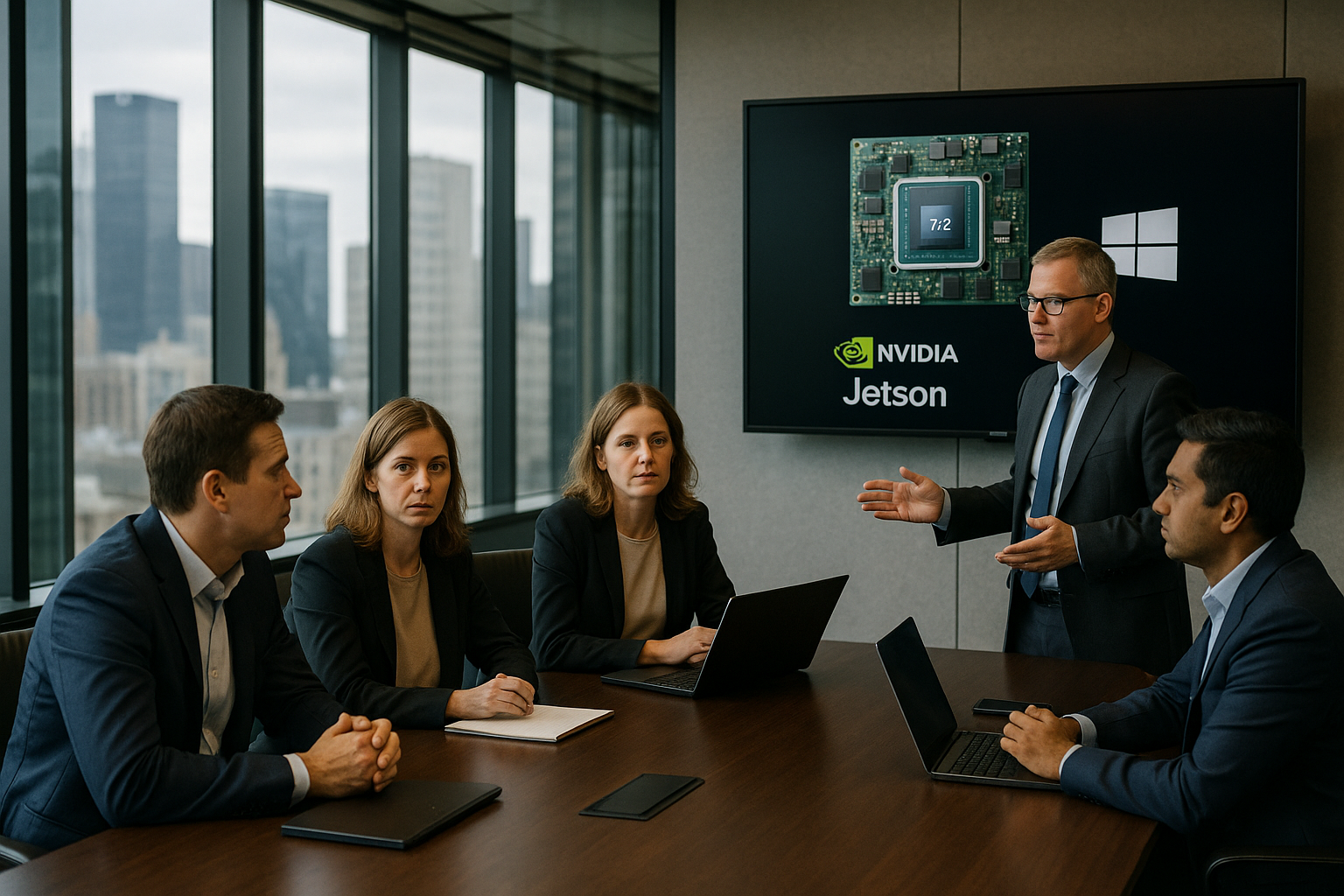
NVIDIA's announcement of JetPack 7.2 and expanded NemoClaw support on Jetson hardware represents a significant infrastructure push beyond GPUs into the software middleware that locks customers into NVIDIA's compute ecosystem. The timing is deliberate: as agentic AI applications move from research labs into production, enterprises face fragmentation across deployment targets—Windows PCs, Jetson edge devices, and cloud instances. By bundling agent-specific software optimizations with Jetson's embedded processors and partnering with Microsoft on a unified stack spanning Windows devices to Azure cloud infrastructure, NVIDIA is positioning itself as the end-to-end infrastructure provider for the emerging agentic AI era. This move directly competes with ARM-based alternatives and cloud-native deployment models that don't rely on NVIDIA acceleration.
JetPack 7.2 brings concrete performance improvements unavailable in prior versions: CUDA 13 integration on Jetson Orin substantially accelerates tensor operations required for long-context reasoning tasks that agentic AI demands. The addition of Yocto project support signals optimization for custom industrial deployments—critical for manufacturing, robotics, and autonomous systems where enterprises need to control firmware and dependencies. Industrial software vendors are already leveraging NVIDIA's NemoClaw framework to build autonomous AI engineers that handle computer-aided design, meshing, and simulation workflows. A manufacturing company using Jetson for real-time robotic control can now deploy trained agent models with the same CUDA-optimized runtime across factory floors and cloud simulation environments, eliminating the recompilation and reoptimization cycles that previously consumed engineering resources.
Microsoft's 'unified stack' partnership addresses a critical pain point in agentic deployment: secure runtimes, responsive data layers, and model inference optimization that spans from Windows devices to cloud. Rather than enterprises building custom orchestration layers, the partnership standardizes how agents authenticate, execute long-running reasoning tasks, and access data across environments. This captures Microsoft's Windows installed base and Azure cloud customers while anchoring them to NVIDIA's GPU-accelerated inference. The NVIDIA AI Cloud ecosystem expansion globally—partners expanding capacity to meet enterprise demand—suggests the market inflection point has arrived: agentic AI is moving beyond prototypes into production scaling. NVIDIA's infrastructure play, amplified by this Microsoft alignment, creates switching costs beyond hardware into software distribution and security models that favor early adopters of the unified stack approach.