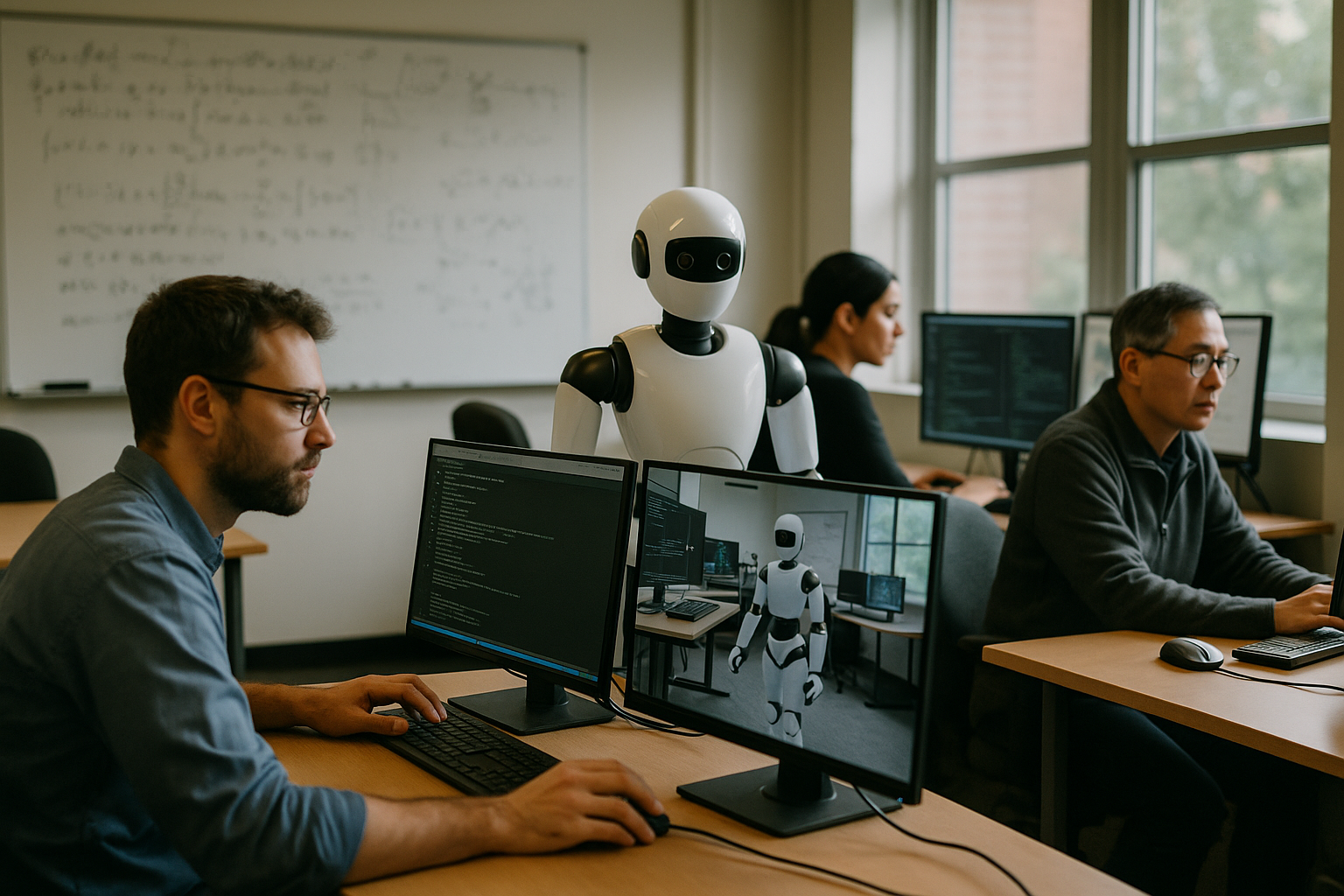
A fundamental mismatch has plagued robotics: the attention mechanisms powering modern large language models rely on key-value (KV) caches optimized for datacenter inference, where short requests batch together and reset frequently. But robots operate differently—they execute single, continuous episodes lasting minutes or hours without resetting, causing memory to balloon linearly with sequence length. Researchers at leading institutions have now solved this with AURA (Action-Gated Memory for Robot Policies), which maintains constant VRAM consumption regardless of episode duration. By gating memory updates based on actions rather than every token, AURA preserves the reasoning capability needed for long-horizon tasks while dramatically reducing the hardware requirements for deployment. This shifts embodied AI from requiring datacenter-grade GPUs to running on edge devices with modest memory budgets.
The breakthrough addresses a critical bottleneck in autonomous systems. Existing transformer-based robot controllers face exponential memory scaling as episodes extend—a fatal flaw when robots must operate continuously in real-world environments. AURA decouples context retention from token count by selectively updating memory only when the robot's actions warrant it, not on every inference step. Testing demonstrates that policies maintain planning and reasoning quality while eliminating the computational overhead that previously forced roboticists to either truncate context windows or deploy expensive server-backed systems. This enables truly autonomous edge deployment, where robots make decisions onboard without latency-sensitive network calls to cloud infrastructure.
The achievement reflects broader momentum in specialized AI architectures that challenge datacenter-first assumptions. Concurrent research addressing similar inefficiencies—from graph-enhanced reasoning in LLMs to domain-specific memory designs for weather prediction and clinical AI—suggests the field is moving beyond one-size-fits-all models toward purpose-built systems. For robotics specifically, AURA's constant-memory guarantee is a watershed moment: autonomous systems can now scale to longer, more complex real-world tasks while remaining deployable on robots' actual hardware constraints. This research paves the way for genuinely autonomous agents operating in homes, factories, and field environments without dependence on cloud connectivity.