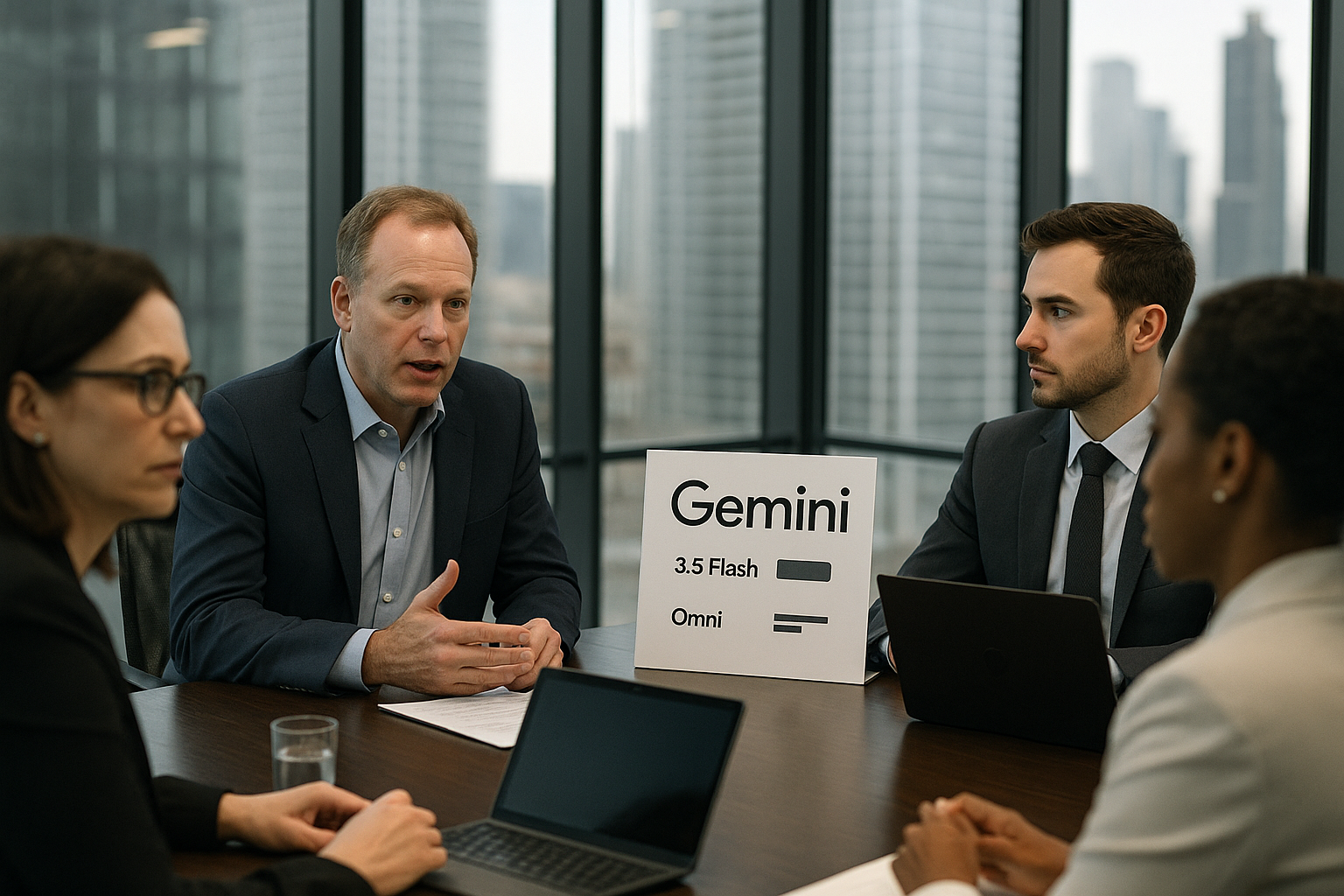
Google's announcement of Gemini Omni and Gemini 3.5 Flash at I/O 2026 represents a significant strategic pivot: rather than consolidating around a single premium model, DeepMind is doubling down on a tiered approach designed to capture both the high-performance and cost-conscious segments of the enterprise AI market. Gemini Omni targets the performance ceiling—handling multimodal tasks with native support for video, audio, and text in ways that position it as a direct competitor to OpenAI's GPT-4 Turbo and Anthropic's Claude 3.5 Sonnet. Gemini 3.5 Flash, meanwhile, prioritizes speed and efficiency, targeting latency-sensitive applications where traditional large models introduce unacceptable delays. This dual-model strategy suggests Google is no longer betting on a single architectural winner; instead, it's hedging by owning both the performance and speed tiers simultaneously.
The competitive stakes are substantial. OpenAI's GPT-4 and Claude dominate enterprise deployments partly because they offer a single, trusted model that handles diverse workloads acceptably well. Google's split strategy introduces complexity but also optionality—customers can choose based on use case rather than being locked into a one-size-fits-all constraint. The irony is particularly sharp here: Google used Gemini models to build the I/O presentation itself and powered an interactive quiz through Google AI Studio, effectively dogfooding its own technology as the primary marketing vehicle. This self-referential loop demonstrates confidence in production readiness but also risks appearing circular if the models' real-world performance diverges from their showcase applications. The nine released demos of both models suggest Google is betting that transparency about capabilities will outweigh skepticism.
Strategically, this move reflects Google's recognition that the AI market is fragmenting beyond raw capability benchmarks. Enterprises increasingly care about inference costs, latency, and task-specific optimization—factors that neither Omni nor competitors' monolithic models fully satisfy. By releasing both Omni and 3.5 Flash as distinct products with explicit positioning, Google is signaling that the era of single flagship models may be ending. The question now is whether the market will accept managing two separate models within its stack, or whether OpenAI's simplicity-through-consolidation approach will retain the advantage despite higher per-inference costs. Google's bet is that optionality beats uniformity.