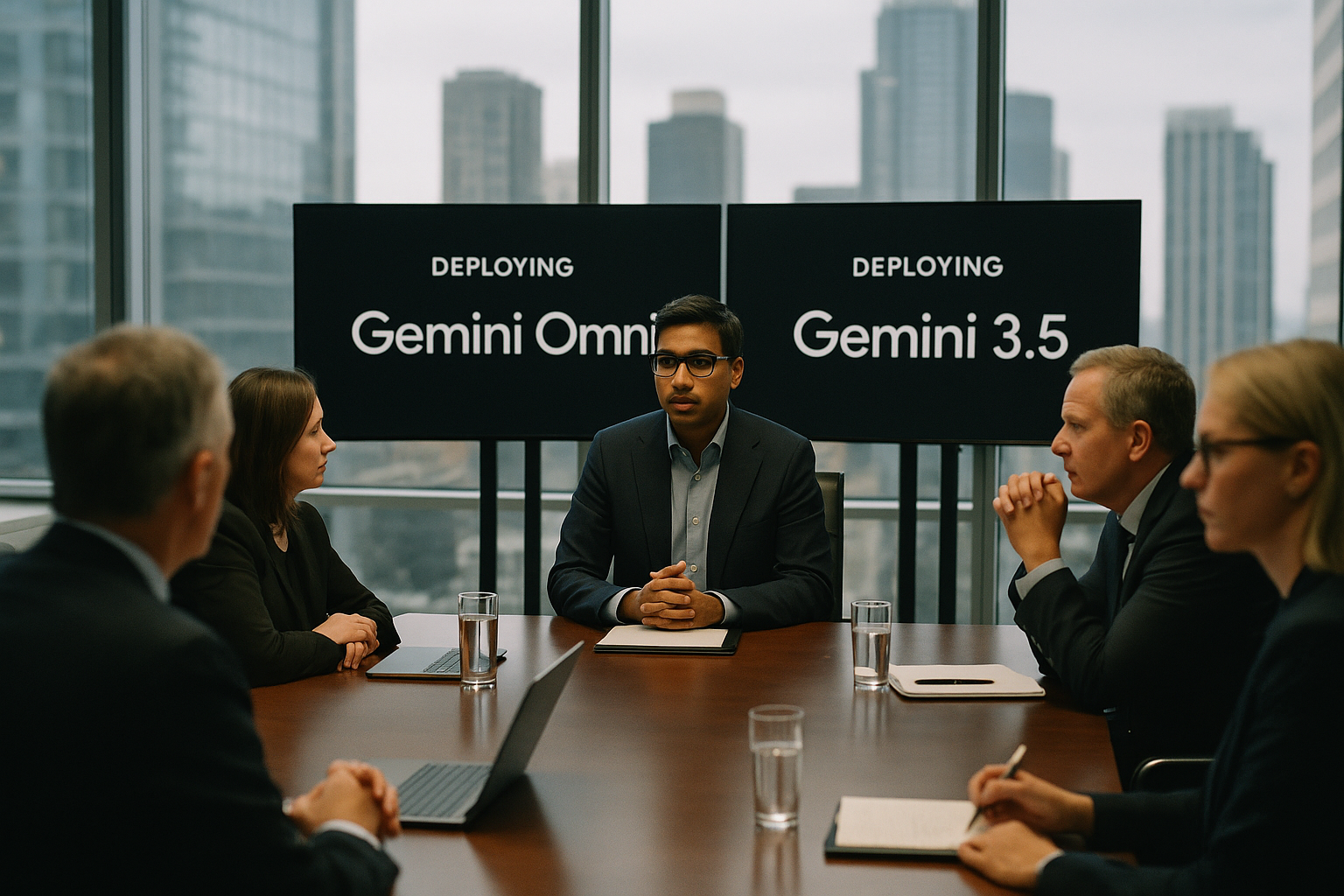
Google DeepMind marked a significant strategic shift at I/O 2026 by releasing two Gemini models simultaneously rather than positioning one as a clear successor to the other. Gemini Omni and Gemini 3.5 represent a divergence in Google's AI product roadmap, with the company publicly demonstrating both models through nine capability videos while maintaining both in its product lineup. This dual-model strategy contrasts sharply with how competitors like OpenAI and Anthropic typically shepherd users toward their latest flagship releases. The move raises a fundamental question about model maturity: if Omni were unambiguously superior, why does Google need to keep 3.5 in active development and promotion? The answer may lie in cost, latency, and domain-specific performance tradeoffs that suggest Omni excels at certain tasks while 3.5 remains the pragmatic choice for others.
More revealing than the dual release is Google's public disclosure that internal teams used Gemini to build Google I/O itself. Google AI Studio was used to develop a 'vibe coded' quiz about I/O announcements, while Gemini powered content creation and production workflows for the conference. This dogfooding—using your own products to solve real problems—carries weight in enterprise procurement conversations because it answers a critical CTO question: does Google actually trust these models? Meta and OpenAI rarely publicize internal use cases at this level of detail. By contrast, Google is explicitly claiming that its own engineers found Gemini sufficiently reliable for high-stakes, public-facing work. The Futures Lab partnership with University of Waterloo, where students built AI prototypes including sign language tutors, further extends this narrative into education and accessibility—domains where model reliability directly impacts users' lives.
However, Google's messaging obscures tensions in its strategy. The company announced AI-powered thrift shopping discovery in Google Search and Shopping, but these applications typically demand lighter cognitive loads than the research or content production work that Gemini performed at I/O. The gap between internal confidence (using Gemini for conference production) and external product positioning (shopping recommendations, quiz generation) suggests Omni may not yet be mature enough for all enterprise workloads consistently. This matters because Google Cloud is competing directly with AWS's Bedrock and Azure's OpenAI integration for enterprise AI wallet share. A CTO evaluating these platforms needs evidence not just of capability demonstrations, but of production reliability and cost efficiency at scale. Google's willingness to say 'we use this internally' is a competitive signal, but the simultaneous retention of 3.5 implies Omni carries tradeoffs—likely around inference cost or latency—that make it unsuitable as a universal replacement. Until Google articulates which workloads demand which model, enterprise buyers will remain uncertain whether the Gemini strategy represents a step forward or a fragmentation of the platform.